
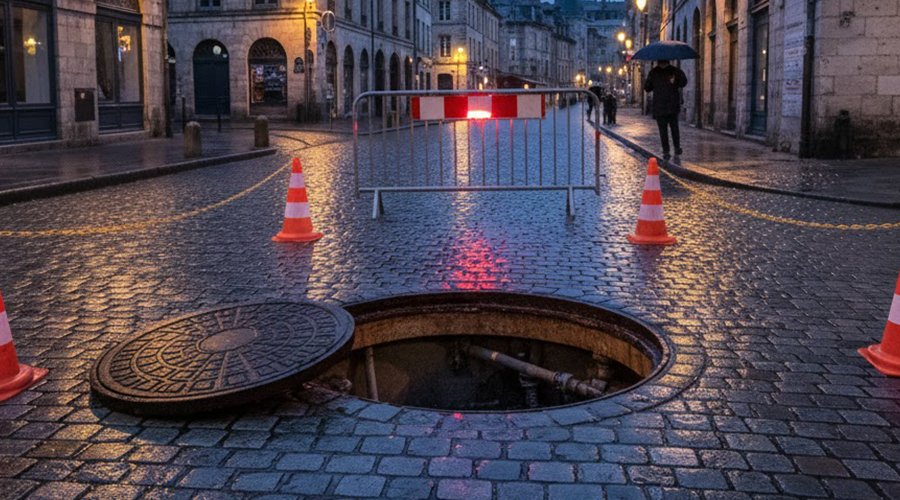
On the night of November 30, three-year-old Ibrahim slipped into an uncovered manhole near Nipa Chowrangi in Gulshan-e-Iqbal, Karachi. He fell right in front of his mother. We can only imagine the shock and devastation she must have felt in that moment, watching her child disappear and being unable to do anything except stand there in helpless grief. For nearly 14 hours, Ibrahim remained somewhere inside the city’s drainage system. It is impossible to fully grasp the fear and suffering he may have endured, or the lifelong burden his mother will now carry. The grief is immeasurable. The gravity of this failure is undeniable.
Open manholes have long plagued Karachi. They sit in the middle of sidewalks, near storefronts, beside bus stops, and in residential lanes where families and children walk every day. For years, they have claimed lives. Children on their way home, motorcyclists navigating traffic, and pedestrians crossing dimly lit streets have all been victims. Complaints to authorities are frequent. Solutions are rare.
Karachi’s civic agencies, the Karachi Metropolitan Corporation and the Karachi Water and Sewerage Corporation, bear responsibility for the city’s drainage infrastructure. Yet the open manholes scattered across Karachi reflect a deeper pattern of institutional neglect. Covers are broken and never replaced. Drainage openings at construction sites are left exposed. Inspections are inconsistent, and maintenance is delayed. These are not small errors or unfortunate oversights. They are signs of a system that has grown accustomed to looking away.
This raises a heavier question. Is this only a failure of institutions, or have we failed as a society as well? We see how drainage covers are stolen, pried open or shattered by dumpers and heavy traffic. We witness the danger. Yet nothing changes. Fatigue, carelessness and a troubling disregard for human life have seeped into everyday behaviour. Responsibility is shared, and so is the guilt.
The tragedy also unfolded against a troubling backdrop. Dumper trucks have become a recurring threat on Karachi’s roads, frequently involved in accidents linked to reckless driving and weak enforcement. CCTV footage later revealed that the manhole near Nipa Chowrangi had originally been covered, but a few days earlier, a dumper had driven over it and broken the lid completely. It was never replaced. The opening remained exposed, unnoticed, and unattended until the night little Ibrahim walked by.
In the aftermath, when questioned by a reporter, Karachi’s mayor criticized the reporter for “making a speech” and insisted that such exchanges were the reason problems remained unresolved. His comments showed neither empathy nor embarrassment that a child had died in this manner under his administration’s watch. And the tragedy did not end with Ibrahim. Only days later, another first grader fell into an open manhole. This time, bystanders pulled the child out immediately, preventing another fatality. How many more warnings does this city need?
The response to Ibrahim’s fall only reinforced the sense of civic failure. Rescue teams arrived without the tools needed for a swift search. Volunteers and residents stepped in to help, even arranging machinery on their own. Officials offered apologies, but apologies cannot replace accountability or safety. Promises cannot repair a system that has allowed such hazards to persist for years.
This year alone, at least two dozen people have died after falling into open manholes or drainage channels in Karachi. Similar incidents in previous years produced the same official assurances, the same public anger and ultimately the same unchanged reality. The pattern is tragically familiar. A preventable death, a wave of outrage, official commitments, and then a slow return to complacency.
Karachi needs more than symbolic responses. It needs a functioning urban safety system. That requires comprehensive inspections, durable and tamper-resistant covers, and clear responsibility for failures. It requires coordination among agencies, transparency in reporting, and repairs carried out before dangers become fatal, not after.
Beyond institutional reform, Karachi needs a collective awakening. Who is responsible for this crisis? Are such failures limited to the system, the mayor and the authorities or do they reflect the choices of all of us when we allow theft, indifference and reckless behaviour to become routine? Solutions demand action from institutions, but they also demand honesty from society. The question we must now confront is not simply what the solution is, but whether we are willing to demand it and uphold it ourselves.
The consequences of inaction fall disproportionately on those who walk the city. Students, labourers, children and families navigate public spaces that should be safe but instead resemble obstacle courses. When basic infrastructure becomes unreliable, public trust erodes. A city that cannot guarantee safe streets cannot claim to protect its residents.
Ibrahim’s death should be a turning point. Karachi may expand its highways, build new corridors and launch ambitious transport projects, but none of it matters if the ground beneath its residents remains unsafe. Progress means little when a child cannot walk with his family without facing mortal danger.
Karachi owes its citizens more than expressions of sympathy. It owes them a city where manholes are covered, roads are regulated, and safety is not left to chance. Until that becomes true, the tragedies that fill Karachi’s headlines will continue to repeat. Each one will be preventable. Each one will stand as a reminder of the city’s failure, and our failure as a society to protect our own people.
Omama Ansari is a marketing and technology professional with an interest in Karachi’s urban challenges and public safety issues.