
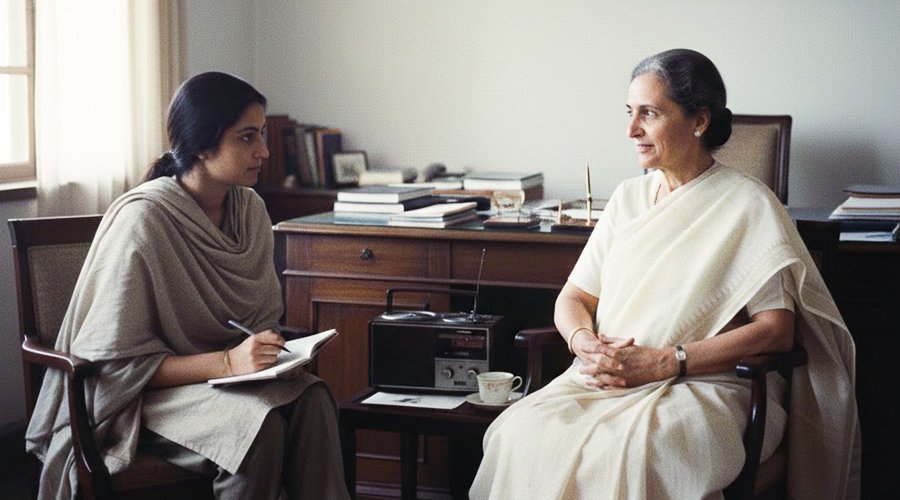
Sometimes the destiny grants your wish even when there seems no remote possibility of it. For veteran journalist Humaira Ather, a distant dream turned into a reality when she got the opportunity to interview Indian Prime Minister Indira Gandhi during her family visit to India in 1980.
The journalist shared her meeting with the ‘Iron Lady’ of India during a podcast on OTS where she conversed with journalist Rana Asif and academic Munib Raza.
She said she was the only Pakistani journalist who interviewed Indira. When asked how it all happened, she said it began with the re-establishment of the Indian consulate in Karachi with notable Indian National Congress leader Mani Shankar Aiyar as the consul general in around 1979.
Humaira recalled that after the 1965 war, India had closed its consulate in Karachi, due to which the residents of Karachi had to travel to Islamabad to obtain the Indian visa.
She told the podcast that she was in her early 20s and working for a periodical, Akhbar-e-Khawateen, when the Indian consulate resumed operations in Karachi after a long hiatus.
She said she was assigned by her editor Shameem Akhter to visit the Indian consulate and write a feature report after interviewing the consul general and other staff. When her report was published, it impressed the consul general so much that he started inviting her to the consulate events and would occasionally ask her if she needed any help from him.
The journalist said that at that time, tourist visas for India were not allowed and only those people could get visas who wanted to visit some relative living in India.
During that time, she learnt that her maternal uncle was going to India with his cousin to meet relatives in Ghazipur. As she expressed her desire to join them, they agreed to take her with them.
It was then Humaira thought of asking Aiyar for a favour. She called him to ask if he could arrange her interview with Indira as she was about to visit India. The consul general was baffled. He frankly told her it was not possible as the Indian prime minister did not like meeting journalists in general and she would definitely not entertain the idea of talking with a Pakistani journalist.
But Humaira persisted and challenged him to arrange the meeting. A few days later, she was informed that an interview date had been set — with one condition: no political questions were to be asked.
However, still more obstacles awaited the young Pakistani journalist. She told the podcast that it took her five days to reach Ghazipur from Karachi and continuous travel on train made her ill. As she did not find herself in good health to meet the Indian prime minister on the scheduled date, she sent a telegram to the prime minister office requesting them to fix another date for the interview.
The reply came but it was a little too late. When she received the mail after over 10 days, she found that the prime minister office had rescheduled the interview date but that date had already passed by the time she got the information.
The determined reporter again tried her luck. She called the prime minister office only to find an officer reprimanding her for not showing up for the interview. She asked him to give her appointment so that she could come to him and explain in person.
When she met the officer the following day, he was still angry. He told her she was an irresponsible journalist who wasted the time of the Indian prime minister who waited for her for half an hour. However, when Humaira told him that the fault was not hers but the Indian postal service’s, he agreed to set up another date for the interview.
Finally, around the middle of March 1980, Humaira met Indira. She found her as a simple and elegant woman clad in a cotton sari. The Indian prime minister’s office, she recalled, was also simple without much decoration and pomp. The press officer’s office in Karachi at that time was bigger and more furnished than the Indian prime minister’s office, she said
She was given half an hour to interview Indira, during which she asked her about her family and other women-centric questions such as the secret of her beauty in that age. As the interviewer had recently seen a picture of Indira dancing with some women, she asked her if she had receiving formal training in dance.
When the 30 minutes were over, the prime minister’s secretary intervened and announced that the time was over. However, Humaira had other ideas. She asked Indira whether it would make a good impression of any of them if the interview had no questions about politics given that Indira was the prime minister of a large democratic country in the world and belonged to a family of politicians.
This made Indira reconsider her condition for allowing the interview. Humaira requested her to allow her to ask just two questions pertaining to politics. The request was approved and the Pakistani journalist ended the interview with asking two questions on the Soviet invasion of Afghanistan and Kashmir issue.
Humaira said she deliberately avoided the subject of 1971 war and Indian emergency as they might have provoked the Indian prime minister. In response to the Kashmir question, Indira countered by asking whether Kashmir was even an issue.
The veteran journalist said she found Indira as a graceful and kind woman contrary to the general perception about her. She added that when Indira’s son Sanjay Gandhi died in a crash, she sent a condolence message to her, to which she sent a reply to her expressing gratitude for her condolences.